Development of a Mortality Prediction Score for Patients With Hip Fractures
DOI:
https://doi.org/10.56929/jseaortho-2026-0330Keywords:
Hip fracture, mortality prediction, prognostic scoring system, fragility hip fracture, risk-stratificationAbstract
Purpose: This study developed and validated a context-specific Hip Fracture Mortality Score (HFMS) to predict 1-year mortality in Thai patients.
Methods: A retrospective cohort analysis evaluated consecutive hip fracture admissions at Nan Hospital (January 2019–December 2023), including 1,263 patients aged ≥60 years. Twenty-four candidate predictors were analyzed using univariate logistic regression; variables with p < 0.20 entered multivariate analysis. Beta coefficients were transformed into point values (rounded to the nearest 0.5) for clinical implementation.
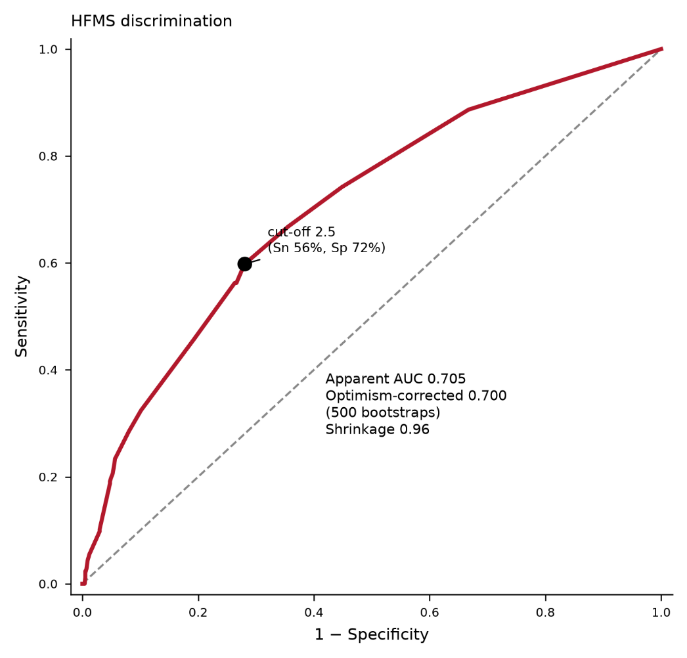
Results: The overall 1-year mortality rate was 20.3%. Five independent predictors were identified: end-stage renal disease (adjusted odds ratio [aOR] 4.64, 95% confidence interval [CI] 2.097–10.263; 4 points), non-operative management (aOR 2.64, 95% CI 1.667–4.192; 2.5 points), anemia (aOR 2.02, 95% CI 1.451–2.807; 2 points), male sex (aOR 1.80, 95% CI 1.289–2.504; 1.5 points), and walking with aids (aOR 1.43, 95% CI 1.049–1.941; 1 point). The HFMS showed moderate discrimination (area under the curve [AUC] 0.701, 95% CI 0.666–0.737; optimism-corrected AUC 0.700 on bootstrap validation). A 2.5-point threshold (Youden’s index: 0.296) yielded a sensitivity of 56.3%, specificity of 73.4%, positive predictive value of 35.0%, and negative predictive value (NPV) of 86.8%. Low-risk patients (<2.5 points) had mortality rates of 7.97–20% versus 27.84–53.85% in high-risk patients (≥2.5 points).
Conclusions: The HFMS is a practical prognostic tool using five ascertainable parameters, avoiding complex algorithms. It addresses the limitations of Western-derived scoring systems in resource-constrained Thai healthcare settings. Despite moderate sensitivity, a high NPV effectively identifies low-risk patients. External validation and prospective evaluation warrant further investigation.
Metrics
References
Cooper C, Campion G, Melton LJ 3rd. Hip fractures in the elderly: a world-wide projection. Osteoporos Int 1992;2:285-9.
National Economic and Social Development Council. Share of total population older than 60 years old in Thailand between 2022 and 2023, with a forecast to 2040. Bangkok: National Economic and Social Development Council; 2024. Available from: https://www.statista.com/ statistics/713667/thailand-forecast-aging-population/. Accessed October 4, 2024.
Wongtriratanachai P, Luevitoonvechkij S, Songpatanasilp T, et al. Increasing incidence of hip fracture in Chiang Mai, Thailand. J Clin Densitom 2013;16:347-52.
Sucharitpongpan W, Daraphongsataporn N, Saloa S, et al. Epidemiology of fragility hip fractures in Nan, Thailand. Osteoporos Sarcopenia 2019;5:19-22.
Charatcharoenwitthaya N, Nimitphong H, Wattanachanya L, et al. Epidemiology of hip fractures in Thailand. Osteoporos Int 2024;35:1661-8.
Harvey LA, Payne NL, Tan A, et al. Variation in mortality following hip fracture across the Asia Pacific region: systematic review and proportional meta-analysis. Arch Gerontol Geriatr 2024;126:105519.
Daraphongsataporn N, Saloa S, Sriruanthong K, et al. One-year mortality rate after fragility hip fractures and associated risk in Nan, Thailand. Osteoporos Sarcopenia 2020;6:65-70.
Hu F, Jiang C, Shen J, et al. Preoperative predictors for mortality following hip fracture surgery: a systematic review and meta-analysis. Injury 2012;43:676-85.
Maxwell MJ, Moran CG, Moppett IK. Development and validation of a preoperative scoring system to predict 30 day mortality in patients undergoing hip fracture surgery. Br J Anaesth 2008;101:511-7.
Copeland GP, Jones D, Walters M. POSSUM: a scoring system for surgical audit. Br J Surg 1991;78:355-60.
Kitcharanant N, Chotiyarnwong P, Tanphiriyakun T, et al. Development and internal validation of a machine-learning-developed model for predicting 1-year mortality after fragility hip fracture. BMC Geriatr 2022;22:451.
Liu Y, Wang Z, Xiao W. Risk factors for mortality in elderly patients with hip fractures: a meta-analysis of 18 studies. Aging Clin Exp Res 2018;30:323-30.
Sheehan KJ, Sobolev B, Guy P. Mortality by timing of hip fracture surgery: factors and relationships at play. J Bone Joint Surg Am 2017;99:e106.
Sheikh HQ, Hossain FS, Aqil A, et al. A comprehensive analysis of the causes and predictors of 30-day mortality following hip fracture surgery. Clin Orthop Surg 2017;9:10-8.
Folbert EC, Hegeman JH, Vermeer M, et al. Improved 1-year mortality in elderly patients with a hip fracture following integrated orthogeriatric treatment. Osteoporos Int 2017;28:269-77.
Nordström P, Gustafson Y, Michaëlsson K, et al. Length of hospital stay after hip fracture and short-term risk of death after discharge: a total cohort study in Sweden. BMJ 2015;350:h696.
Seekan U, Sucharitpongpan W. Primary prevention of fragility hip fracture in high-risk elderly by village health volunteers in Nan Province, Thailand. J Med Assoc Thai 2025;108:361-9.
Downloads
Published
How to Cite
Issue
Section
License
Copyright (c) 2026 The Royal College of Orthopaedic Surgeons of Thailand

This work is licensed under a Creative Commons Attribution-NonCommercial 4.0 International License.