Incidence of Postoperative Urinary Tract Infection in Fragility Hip Fracture after Preoperative Urinary Catheter: A Randomized Controlled Trial
DOI:
https://doi.org/10.56929/jseaortho-2026-0316Keywords:
Fragility hip fracture, Urinary tract infection, Urinary catheterization, Postoperative complicationsAbstract
Purpose: Urinary tract infection (UTI) is a prevalent complication following fragility hip fractures in the elderly, significantly impacting morbidity and mortality. Whether preoperative urinary catheterization mitigates or exacerbates this risk remains a subject of clinical debate. This study evaluates the impact of preoperative urinary catheterization on the incidence of postoperative UTI in patients aged 60 years and older undergoing surgery for fragility hip fractures.
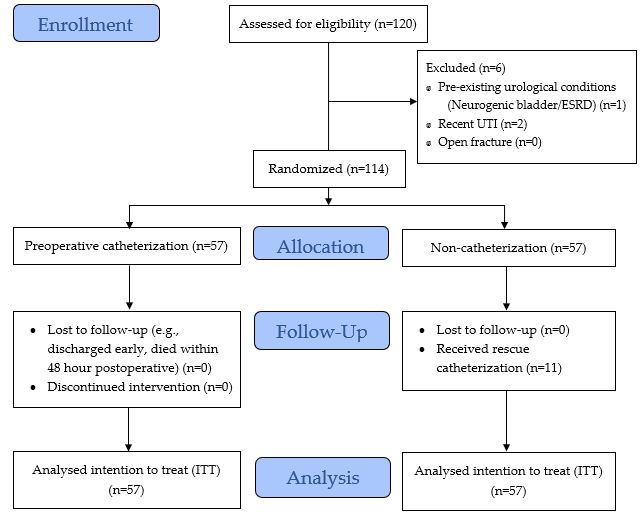
Methods: In this prospective randomized controlled trial, 114 elderly patients were randomized (1:1) into either a preoperative urinary catheter (PUC) group or non-urinary catheter (NUC) group at a single tertiary center. The primary outcome was the incidence of symptomatic UTI (SUTI). Secondary outcomes included asymptomatic bacteremic UTI (ABUTI), acute urinary retention (AUR), postoperative pneumonia, and length of hospital stay (LOS).
Results: Among the 114 patients analyzed, the incidence of SUTI was higher in the PUC group than in the NUC group; however, this did not reach statistical significance. Similarly, the rate of ABUTI was identical in both groups. The NUC group exhibited a higher incidence of AUR (19.30% vs. 8.77%); however, the difference was not statistically significant. Notably, the PUC group experienced a significantly higher rate of postoperative pneumonia and prolonged mean LOS.
Conclusions: Routine preoperative urinary catheterization in elderly patients with fragility hip fractures was associated with a higher clinical trend of symptomatic UTIs, significantly increased rates of postoperative pneumonia, and prolonged hospital stays. The findings show that avoiding routine catheterization may help mitigate systemic complications and facilitate recovery.
Metrics
References
Clynes MA, Harvey NC, Curtis EM, et al. The epidemiology of osteoporosis. Br Med Bull 2020;133:105-17. DOI: https://doi.org/10.1093/bmb/ldaa005
Sucharitpongpan W, Daraphongsataporn N, Saloa S, et al. Epidemiology of fragility hip fractures in Nan, Thailand. Osteoporos Sarcopenia 2019;5:19-22. DOI: https://doi.org/10.1016/j.afos.2019.03.003
Jaruwan C. Comparison of urinary tract infection in elderly hip fracture patients in a secondary care hospital: early versus delayed insertion of urinary catheters. J Med Assoc Thai 2025;108:174-80. DOI: https://doi.org/10.35755/jmedassocthai.2025.3.174-180-01388
Bliemel C, Buecking B, Hack J, et al. Urinary tract infection in patients with hip fracture: An underestimated event? Geriatr Gerontol Int 2017;17:2369-75. DOI: https://doi.org/10.1111/ggi.13077
Lin YC, Hsu YC, Wu WT, et al. The incidence of severe urinary tract infection increases after hip fracture in the elderly: a nationwide cohort study. Sci Rep 2021;11:3374. DOI: https://doi.org/10.1038/s41598-021-83091-6
Johnstone DJ, Morgan NH, Wilkinson MC, et al. Urinary tract infection and hip fracture. Injury 1995;26:89-91. DOI: https://doi.org/10.1016/0020-1383(95)92183-B
Wang W, Yao W, Tang W, et al. Risk factors for urinary tract infection in geriatric hip fracture patients: a systematic review and meta-analysis. Front Med (Lausanne) 2024;11:1360058. DOI: https://doi.org/10.3389/fmed.2024.1360058
Assadi F. Strategies for preventing catheter-associated urinary tract infections. Int J Prev Med 2018;9:50. DOI: https://doi.org/10.4103/ijpvm.IJPVM_299_17
Centers for Disease Control and Prevention (CDC). Urinary tract infection (catheter-associated urinary tract infection [CAUTI] and non-catheter-associated urinary tract infection [UTI]) events: Device-associated module. Atlanta (GA): CDC; 2025 Jan.
Hooton TM, Bradley SF, Cardenas DD, et al. Diagnosis, prevention, and treatment of catheter-associated urinary tract infection in adults: 2009 International Clinical Practice Guidelines from the Infectious Diseases Society of America. Clin Infect Dis 2010;50:625-63. DOI: https://doi.org/10.1086/650482
Johansson I, Athlin E, Frykholm L, et al. Intermittent versus indwelling catheters for older patients with hip fractures. J Clin Nurs 2002;11:651-6. DOI: https://doi.org/10.1046/j.1365-2702.2002.00646.x
Zhang W, Liu A, Hu D, et al. Indwelling versus intermittent urinary catheterization following total joint arthroplasty: A systematic review and Meta-Analysis. PLoS One 2015;10:e0130636. DOI: https://doi.org/10.1371/journal.pone.0130636
Tobu S, Noguchi M, Hashikawa T, et al. Risk factors of postoperative urinary retention after hip surgery for femoral neck fracture in elderly women. Geriatr Gerontol Int 2014;14:636-9. DOI: https://doi.org/10.1111/ggi.12150
Baldini G, Bagry H, Aprikian A, et al. Postoperative urinary retention: anesthetic and perioperative considerations. Anesthesiology 2009;110:1139-57. DOI: https://doi.org/10.1097/ALN.0b013e31819f7aea
Cacciatore S, Ferrara MC, Iuorio MS, et al. Urinary catheterization management in older adults with hip fracture: A systematic review. JAMDA 2025;26:105410. DOI: https://doi.org/10.1016/j.jamda.2024.105410
Tantigate D, Jansatjawan N, Adulkasem N, et al. Risk factors for postoperative urinary retention in fragility hip fracture patients: a prospective study. BMC Geriatr 2024;24:483. DOI: https://doi.org/10.1186/s12877-024-05101-2
Arroyo-Huidobro M, López de la Fuente J, Riera Pagespetit M, et al. Incidence of urinary incontinence after hip fracture surgery and associated risk factors: a prospective study. BMC Geriatr 2024;24:3. DOI: https://doi.org/10.1186/s12877-023-04597-4
Folbert EC, Hegeman JH, Gierveld R, et al. Complications during hospitalization and risk factors in elderly patients with hip fracture following integrated orthogeriatric treatment. Arch Orthop Trauma Surg 2017;137:507-15. DOI: https://doi.org/10.1007/s00402-017-2646-6
Downloads
Published
How to Cite
Issue
Section
License
Copyright (c) 2026 The Royal College of Orthopaedic Surgeons of Thailand

This work is licensed under a Creative Commons Attribution-NonCommercial 4.0 International License.