Patellar Resurfacing and Crepitation After Total Knee Arthroplasty, Propensity Score Matching
DOI:
https://doi.org/10.56929/jseaortho-2026-0312Keywords:
total knee arthroplasty, patellar resurfacing, patellar crepitation, posterior-stabilized knee, propensity score matchingAbstract
Purpose: Patellar crepitation (PC) is a complication of posterior-stabilized total knee arthroplasty (PS-TKA). However, the role of patellar resurfacing (PR) in the reduction of PC remains controversial. This study aimed to evaluate the effectiveness of PR in reducing PC after PS-TKA.
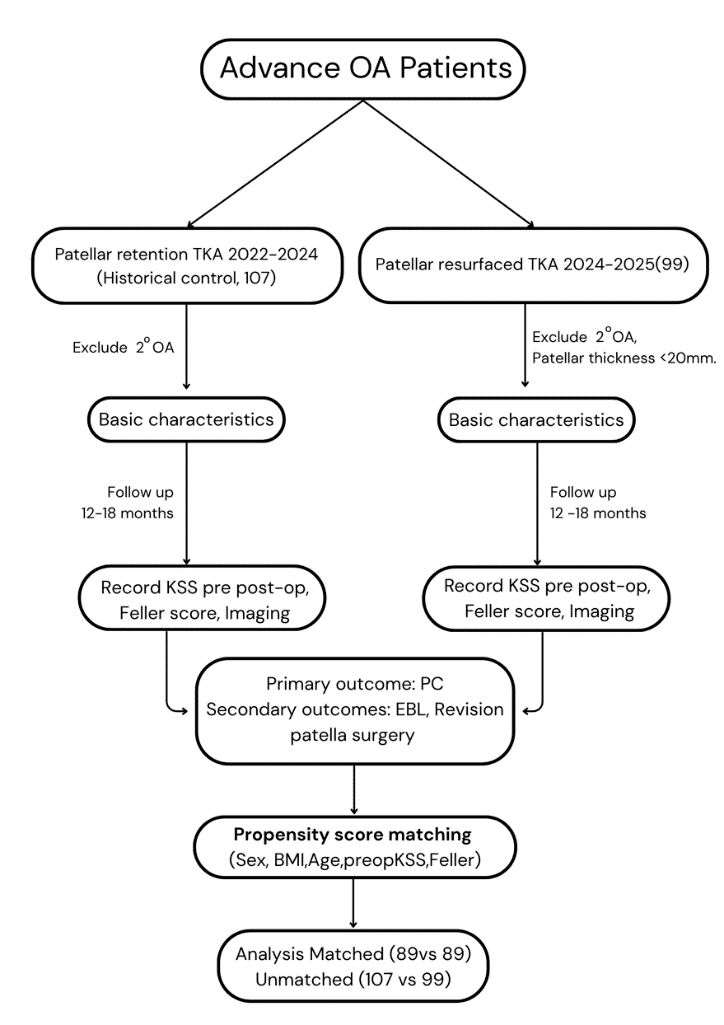
Methods: This retrospective comparative study included patients aged 55–80 years with Kellgren–Lawrence grades 3–4 knee osteoarthritis who underwent PS-TKA. The patients were divided into resurfaced and non-resurfaced groups. Propensity score matching using sex, body mass index, age, preoperative Knee Society Score, and preoperative Feller score produced 89 matched patients per group. The primary outcome was the presence of patellar crepitus. Secondary outcomes included blood loss, radiographic patellar alignment, functional scores, and complications.
Results: The incidence of PC was significantly lower in the resurfaced group than that in the non-resurfaced group (15.7% vs. 77.5%, p<0.001). The estimated blood loss was higher in the resurfaced group, but the difference was not clinically significant. Functional outcomes were comparable between groups, whereas the Feller knee score and patellar shift favored the resurfaced group.
Conclusions: PR significantly reduces PC and improves patellofemoral function after PS-TKA without increasing the complication rates.
Metrics
References
Wing CK, Kwok-Hing C. Sixteen years’ result of posterior-stabilized TKA. J Knee Surg 2012; 25:245-8. DOI: https://doi.org/10.1055/s-0031-1299655
Colizza WA, Insall JN, Scuderi GR. The posterior stabilized total knee prosthesis. Assessment of polyethylene damage and osteolysis after a ten-year-minimum follow-up. J Bone Joint Surg Am 1995;77:1713-20 DOI: https://doi.org/10.2106/00004623-199511000-00011
Thiengwittayaporn S, Srungboonmee K, Chiatakool B. Resurfacing in a posterior-stabilized total knee arthroplasty reduces patella crepitus complication: a randomized, controlled trial. J arthroplasty 2019;34:1969-74. DOI: https://doi.org/10.1016/j.arth.2019.04.050
Ranawat AS, Ranawat CS, Slamin JE, et al. Patellar crepitation in the P.F.C. sigma total knee system. Orthopedics 2006;29(9 suppl):S68-70.
Clarke HD, Fuchs R, Scuderi GR, et al. The influence of femoral component design in the elimination of patella clunk in posterior-stabilized total knee arthroplasty. J Arthroplasty 2006;21:167-71. DOI: https://doi.org/10.1016/j.arth.2005.05.024
Fukunaga K, Kobayashi A, Minoda Y, et al. The incidence of patella clunk syndrome in a recently designed mobile-bearing posteriorly stabilized total knee replacement. J Bone Joint Surg Br 2009;91:463-8. DOI: https://doi.org/10.1302/0301-620X.91B4.21494
Schroer WC, Diesfeld PJ, Reedy ME, et al. Association of increased knee flexion and patella clunk syndrome after mini-subvastus total knee arthroplasty. J Arthroplasty 2009;24:281-7 DOI: https://doi.org/10.1016/j.arth.2007.10.005
Dennis DA, Kim RH, Johnson DR, et al. The John Insall Award: control-matched evaluation of painful patellar crepitus after total knee arthroplasty. Clin Orthop Relat Res 2011;469:10-7 DOI: https://doi.org/10.1007/s11999-010-1485-3
Conrad DN, Dennis DA. Patellofemoral crepitus after total knee arthroplasty: etiology and preventive measures. Clin Orthop Surg 2014;6:9-19 DOI: https://doi.org/10.4055/cios.2014.6.1.9
Ogawa H, Matsumoto K, Akiyama H. Effect of patellar resurfacing on patellofemoral crepitus in posterior-stabilized total knee arthroplasty. J Arthroplasty 2016;31:1792-6. DOI: https://doi.org/10.1016/j.arth.2016.01.023
Ali A, Lindstrand A, Nilsdotter A, et al. Similar patient-reported outcomes and performance after total knee arthroplasty with or without patellar resurfacing: a randomized study of 74 patients with 6-year follow-up. Acta Orthop 2016;87:274-9. DOI: https://doi.org/10.3109/17453674.2016.1170548
Breeman S, Campbell M, Dakin H, et al. Patellar resurfacing in total knee replacement: five-year clinical and economic results of a large multicenter trial. J Bone Joint Surg Am 2011;93:1473-81. DOI: https://doi.org/10.2106/JBJS.J.00725
Chen K, Li G, Fu D, et al. Patellar resurfacing versus nonresurfacing in total knee arthroplasty: a meta-analysis of randomised controlled trials. Int Orthop 2013;37:1075-83. DOI: https://doi.org/10.1007/s00264-013-1866-9
Pilling RWD, Moulder E, Allgar V, et al. Patellar resurfacing in primary total knee replacement: a meta-analysis. J Bone Joint Surg Am 2012;94:2270-8. DOI: https://doi.org/10.2106/JBJS.K.01257
Bourne RB, Burnett RS. The consequences of not resurfacing the patella. Clin Orthop Relat Res 2004:(428):166-9. DOI: https://doi.org/10.1097/01.blo.0000147137.05927.bf
Lee CR, Park DH, Heo KS, et al. Long-term outcomes of high-flexion design total knee arthroplasty with a short posterior flange. Clin Orthop Surg 2024;16:251-8. DOI: https://doi.org/10.4055/cios23133
Gerdesmeyer L, Glowalla C, Lasic I, et al. The Vega advanced third generation posterior stabilized total knee arthroplasty system enables the restoration of range of motion for high demanding daily activities - A 5-years follow-up study. PLoS One 2024;19:e0302885. DOI: https://doi.org/10.1371/journal.pone.0302885
Deroche E, Batailler C, Swan J, et al. No difference between resurfaced and non-resurfaced patellae with a modern prosthesis design: a prospective randomized study of 250 total knee arthroplasties. Knee Surg Sports Traumatol Arthrosc 2022;30:1025-38. DOI: https://doi.org/10.1007/s00167-021-06521-y
Downloads
Published
How to Cite
Issue
Section
License
Copyright (c) 2026 The Royal College of Orthopaedic Surgeons of Thailand

This work is licensed under a Creative Commons Attribution-NonCommercial 4.0 International License.