Artificial Intelligence-Based Assessment of Hip Fracture Detection from Radiographic Images: Diagnostic Accuracy Compared with that of Orthopedic Surgeons and Radiologists
DOI:
https://doi.org/10.56929/jseaortho-2026-0292Keywords:
Hip fracture, artificial intelligence, deep learning, YOLOv8, radiograph interpretation, clinical decision supportAbstract
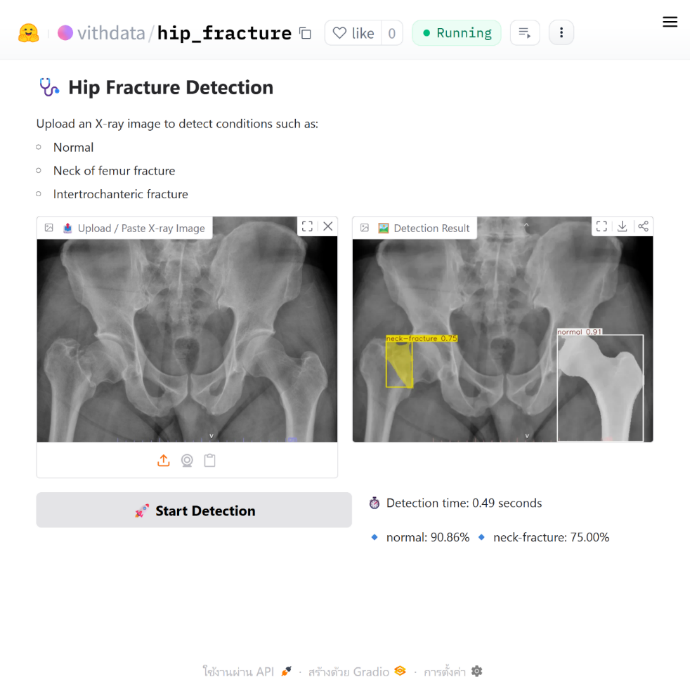
Purpose: Hip fracture is a major global public health concern and one of the leading causes of morbidity and mortality among older adults. Diagnostic inaccuracies often result in delayed treatment and poor outcomes. Artificial intelligence (AI) has shown promise in fracture detection, but studies did not fully reflect real-world clinical practice. We aimed to evaluate the feasibility and capacity of a YOLOv8-based AI model to detect hip fractures from anteroposterior pelvic radiographs as accurately as orthopedic surgeons and radiologists.
Methods: A total of 345 anonymized radiographs were used, comprising 45 images for physician comparison and 300 for extended testing. Various clinicians reviewed 45 images, evenly distributed among normal, femoral neck, and intertrochanteric fractures. Diagnostic accuracy, sensitivity, specificity, and error types were analyzed. The AI model was trained by simulating real-world hospital conditions.
Results: AI achieved an overall accuracy of 0.94, with 0.92 sensitivity and 0.91 specificity, comparable to radiologists and orthopedic surgeons and superior to physicians. Model performance remained stable when tested on the larger dataset (p > 0.05). Most errors occurred in minimally displaced femoral neck fractures, though accuracy for this group improved with larger test data. Mean processing time was 1.9–2.3 seconds per image.
Conclusions: The YOLOv8-based AI system demonstrated expert-level diagnostic performance and high processing efficiency without requiring advanced hardware. Our findings highlight its applicability in hospitals. Although occasional misclassifications and mislocalizations occurred, the model shows promise as a clinical decision-support tool for improving diagnostic confidence, reducing delays, and enhancing patient safety.
Metrics
References
Cooper C, Campion G, Melton LJ. Hip fractures in the elderly: a world-wide projection. Osteoporos Int 1992;2:285-9. DOI: https://doi.org/10.1007/BF01623184
Simunovic N, Devereaux PJ, Sprague S, et al. Effect of early surgery after hip fracture on mortality and complications: systematic review and meta-analysis. CMAJ 2010;182:1609-16. DOI: https://doi.org/10.1503/cmaj.092220
Krogue JD, Cheng KV, Toogood P, et al. Automatic hip fracture identification and classification using deep learning. Radiol Artif Intell 2020;2:e190023. DOI: https://doi.org/10.1148/ryai.2020190023
Cheng CT, Chen CC, Cheng FJ, et al. A human-algorithm integration system for hip fracture detection on plain radiography: system development and validation study. JMIR Med Inform 2020;8:e19416. DOI: https://doi.org/10.2196/19416
Lex JR, Michele JD, Koucheki R, et al. Diagnostic accuracy of deep learning in detecting hip fractures: a systematic review and meta-analysis. JAMA Netw Open 2023;6:e233391. DOI: https://doi.org/10.1001/jamanetworkopen.2023.3391
Kuo RYL, MacKinnon T, Yeom K. Artificial intelligence and deep learning for fracture detection: a systematic review and meta-analysis. Radiology 2022;304:50-62. DOI: https://doi.org/10.1148/radiol.211785
Cheng CT, Ho TY, Lee TY, et al. Application of a deep learning algorithm for detection and visualization of hip fractures on plain pelvic radiographs. Eur Radiol 2019;29:5469-77. DOI: https://doi.org/10.1007/s00330-019-06167-y
Wang LX, Zhu ZH, Chen QC, et al. Development and validation of a deep-learning model for the detection of non-displaced femoral neck fractures with anteroposterior and lateral hip radiographs. Quant Imaging Med Surg 2024;14:1150-62. DOI: https://doi.org/10.21037/qims-23-814
Min H, Rabi Y, Wadhawan A, et al. Automatic classification of distal radius fracture using a two-stage ensemble deep learning framework. Phys Eng Sci Med 2023;46:877-86. DOI: https://doi.org/10.1007/s13246-023-01261-4
Lin TY, Goyal P, Girshick R, He K, Dollár P, editors. Focal loss for dense object detection. Proceedings of the IEEE International Conference on Computer Vision (ICCV); 2017. p.2980-8. DOI: https://doi.org/10.1109/ICCV.2017.324
Guan H, Yap PT, Bozoki A. Federated learning for medical image analysis: A survey. Pattern Recognit 2024;151:110424. DOI: https://doi.org/10.1016/j.patcog.2024.110424
Sheller MJ, Edwards B, Reina GA, et al. Federated learning in medical imaging and genomics: Multi-institutional collaboration without sharing patient data. Sci Rep 2020;10:12598. DOI: https://doi.org/10.1038/s41598-020-69250-1
Downloads
Published
How to Cite
Issue
Section
License
Copyright (c) 2026 The Royal College of Orthopaedic Surgeons of Thailand

This work is licensed under a Creative Commons Attribution-NonCommercial 4.0 International License.