A Biomechanical Analysis of Transverse Patella Fracture Fixation Constructs
DOI:
https://doi.org/10.56929/jseaortho-2026-0284Keywords:
Patella, fracture, fixation, tension-band, wire, screwsAbstract
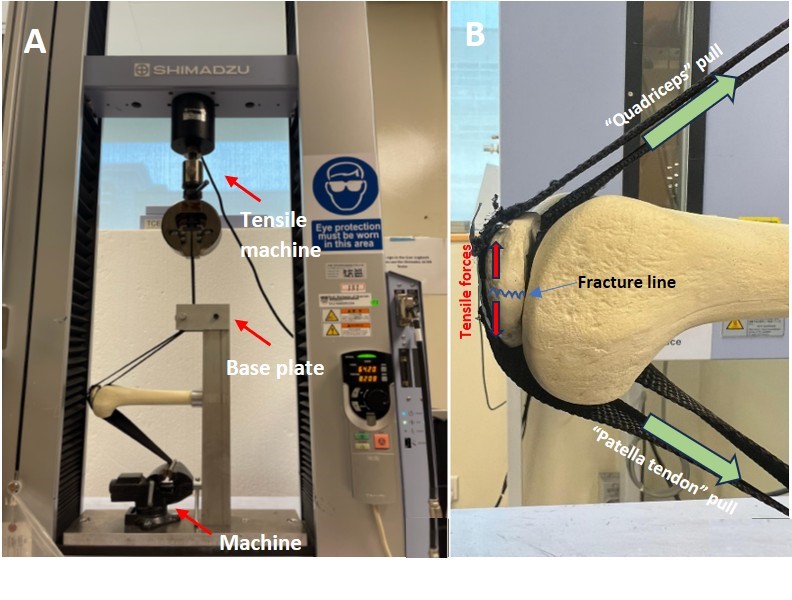
Purpose: Tension-band wiring is a frequently employed surgical technique for patella fractures fixation technique. However, this technique can be disadvantaged by failure of fixation, implant prominence, implant migration, and skin irritation. While alternative fixation techniques have been proposed, few biomechanical studies have been conducted to compare these constructs in a controlled setting. Hence, we designed a biomechanical study to directly compare the strength of constructs that are commonly used in clinical practice.
Methods: A transverse fracture pattern was created on 24 saw-bone patellae. Four different fixation techniques were applied:
- Tension-band wiring (TBW)
- Cannulated lag screws (CLS)
- CLS with PermaTape suture
- CLS with TBW
A distraction force was then progressively applied to the construct until failure occurred. Failure was defined as a sudden plunge in the force-displacement curve or a fracture gap exceeding 2mm.
Results: TBW(A) withstood the smallest load of 535±115 N. CLS(B) fixation was objectively stronger, tolerating a load of 700 ± 62N. This was further augmented with the addition of the PermaTape(C) or TBW(D). CLS with TBW(D) had the highest failure load of 1018±165 N whereas CLS with PermaTape(C) withstood a smaller load of 886±155 N, although the differences between these two groups during post-op analyses were not significant.
Conclusions: CLS(B) alone is a biomechanically stronger construct compared to TBW(A) for transverse patella fractures. Additionally, CLS can be supplemented with synthetic sutures or wires to increase the fixation strength by 20-50% when required.
Metrics
References
Melvin JS, Mehta S. Patellar fractures in adults. J Am Acad Orthop Surg 2011;19:198-207. DOI: https://doi.org/10.5435/00124635-201104000-00004
John J, Wagner WW, Kuiper JH. Tension-band wiring of transverse fractures of patella. The effect of site of wire twists and orientation of stainless steel wire loop: a biomechanical investigation. Int Orthop 2007;31:703-7. DOI: https://doi.org/10.1007/s00264-006-0238-0
Dickens AJ, Salas C, Rise L, et al. Titanium mesh as a low-profile alternative for tension-band augmentation in patella fracture fixation: a biomechanical study. Injury 2015;46:1001-6. DOI: https://doi.org/10.1016/j.injury.2015.02.017
Lee KH, Lee Y, Lee YH, et al. Biomechanical comparison of three tension band wiring techniques for transverse fracture of the patella: Kirschner wires, cannulated screws, and ring pins. J Orthop Surg (Hong Kong) 2019;27:2309499019882140. DOI: https://doi.org/10.1177/2309499019882140
Berg EE. Open reduction and internal fixation of displaced transverse patella fractures with figure-eight wiring through parallel cannulated compression screws. J Orthop Trauma 1997;11:573-6. DOI: https://doi.org/10.1097/00005131-199711000-00005
Wright PB, Kosmopoulos V, Coté RE, et al. FiberWire is superior in strength to stainless steel wire for tension band fixation of transverse patellar fractures. Injury 2009;40:1200-3. DOI: https://doi.org/10.1016/j.injury.2009.04.011
Chapman JR, Harrington RM, Lee KM, et al. Factors affecting the pullout strength of cancellous bone screws. J Biomech Eng 1996;118:391-8. DOI: https://doi.org/10.1115/1.2796022
Thompson JD, Benjamin JB, Szivek JA. Pullout strengths of cannulated and noncannulated cancellous bone screws. Clin Orthop Relat Res 1997;(341):241-9. DOI: https://doi.org/10.1097/00003086-199708000-00035
Bryant TL, Anderson CL, Stevens CG, et al. Comparison of cannulated screws with FiberWire or stainless steel wire for patella fracture fixation: a pilot study. J Orthop 2014;12:92-6. DOI: https://doi.org/10.1016/j.jor.2014.04.011
Posner AD, Hutchinson I, Zimmerman J. Patellar fracture fixation with cannulated compression screws and FiberTape cerclage. Arthrosc Tech 2021;10:e1447-53. DOI: https://doi.org/10.1016/j.eats.2021.02.008
Oh I, Sander TW, Treharne RW. The fatigue resistance of orthopaedic wire. Clin Orthop Relat Res 1985;(192):228-36. DOI: https://doi.org/10.1097/00003086-198501000-00032
Fletcher JWA, Wenzel L, Neumann V, et al. Surgical performance when inserting non-locking screws: a systematic review. EFORT Open Rev 2020;5:26-36. DOI: https://doi.org/10.1302/2058-5241.5.180066
ASTM International. ASTM F1839-08(2021): Standard specification for rigid polyurethane foam for use as a standard material for testing orthopaedic devices and instruments. West Conshohocken (PA): ASTM International; 2021.
Patel VR, Parks BG, Wang Y, et al. Fixation of patella fractures with braided polyester suture: a biomechanical study. Injury 2000;31:1-6. DOI: https://doi.org/10.1016/S0020-1383(99)00190-4
Schindler OS, Scott WN. Basic kinematics and biomechanics of the patellofemoral joint. Part 1: the native patella. Acta Orthop Belg 2011;77:421-31.
Lee TQ. Biomechanics of hyperflexion and kneeling before and after total knee arthroplasty. Clin Orthop Surg 2014;6:117-26. DOI: https://doi.org/10.4055/cios.2014.6.2.117
ASTM International. ASTM F543-17: Standard specification and test methods for metallic medical bone screws. West Conshohocken (PA): ASTM International; 2017.
Smith ST, Cramer KE, Karges DE, et al. Early complications in the operative treatment of patella fractures. J Orthop Trauma 1997;11:183-7. DOI: https://doi.org/10.1097/00005131-199704000-00008
Camarda L, La Gattuta A, Butera M, et al. FiberWire tension band for patellar fractures. J Orthop Traumatol 2016;17:75-80. DOI: https://doi.org/10.1007/s10195-015-0359-6
Lee KW, Ma SB, Yang DS, et al. Open reduction and internal fixation using multiple nonabsorbable suture materials in acute patella fracture: comparison of clinical and radiological outcomes with tension band wiring. Knee Surg Relat Res 2021;33:34. DOI: https://doi.org/10.1186/s43019-021-00116-0
Karadeniz E, Keskinoz EN. A comparison of EFECE systems with tension band wiring for patella fracture fixation in cadavers. J Orthop Surg Res 2020;15:256. DOI: https://doi.org/10.1186/s13018-020-01781-9
Mayurasakorn C, Phiphobmongkol V, Kosuwon W, et al. Cannulated screws and braided polyester tension band as an alternative for fixation of transverse patella fracture: a finite element analysis study. Bangkok Med J 2017;13:11-8. DOI: https://doi.org/10.31524/bkkmedj.2017.09.003
Ali M, Kuiper J, John J. Biomechanical analysis of tension band wiring of transverse fractures of the patella. Chin J Traumatol 2016;19:255-8. DOI: https://doi.org/10.1016/j.cjtee.2016.06.009
Ensminger WP, McIff T, Vopat B, et al. Mechanical comparison of high-strength tape suture versus high-strength round suture. Arthrosc Sports Med Rehabil 2021;3:e1525-34. DOI: https://doi.org/10.1016/j.asmr.2021.07.014
Rodes SA, Favorito PJ, Piccirillo JM, et al. Performance comparison of a pretied suture knot with three conventional arthroscopic knots. Arthroscopy 2015;31:2183-90. DOI: https://doi.org/10.1016/j.arthro.2015.05.014
Avery MC, Jo S, Chang A, et al. Cannulated screw prominence in tension band wiring of patella fractures increases fracture gapping: a cadaver study. Clin Orthop Relat Res 2019;477:1249-55. DOI: https://doi.org/10.1097/CORR.0000000000000683
Maden M, Bayraktar OB, Bacaksiz T, et al. Does protruding headless cannulated screw reduce fixation stability in tension band wiring technique for patella fractures? A biomechanical study. J Orthop Surg Res 2025;20:148. DOI: https://doi.org/10.1186/s13018-025-05567-9
Wild M, Eichler C, Thelen S, et al. Fixed-angle plate osteosynthesis of the patella: an alternative to tension wiring? Clin Biomech (Bristol) 2010;25:341-7. DOI: https://doi.org/10.1016/j.clinbiomech.2009.12.010
Downloads
Published
How to Cite
Issue
Section
License
Copyright (c) 2026 The Royal College of Orthopaedic Surgeons of Thailand

This work is licensed under a Creative Commons Attribution-NonCommercial 4.0 International License.